
A motion sensor light that turns on for no obvious reason can get annoying fast. One minute your backyard is dark and quiet. The next, the floodlight is illuminating the entire fence because a branch moved in the wind.
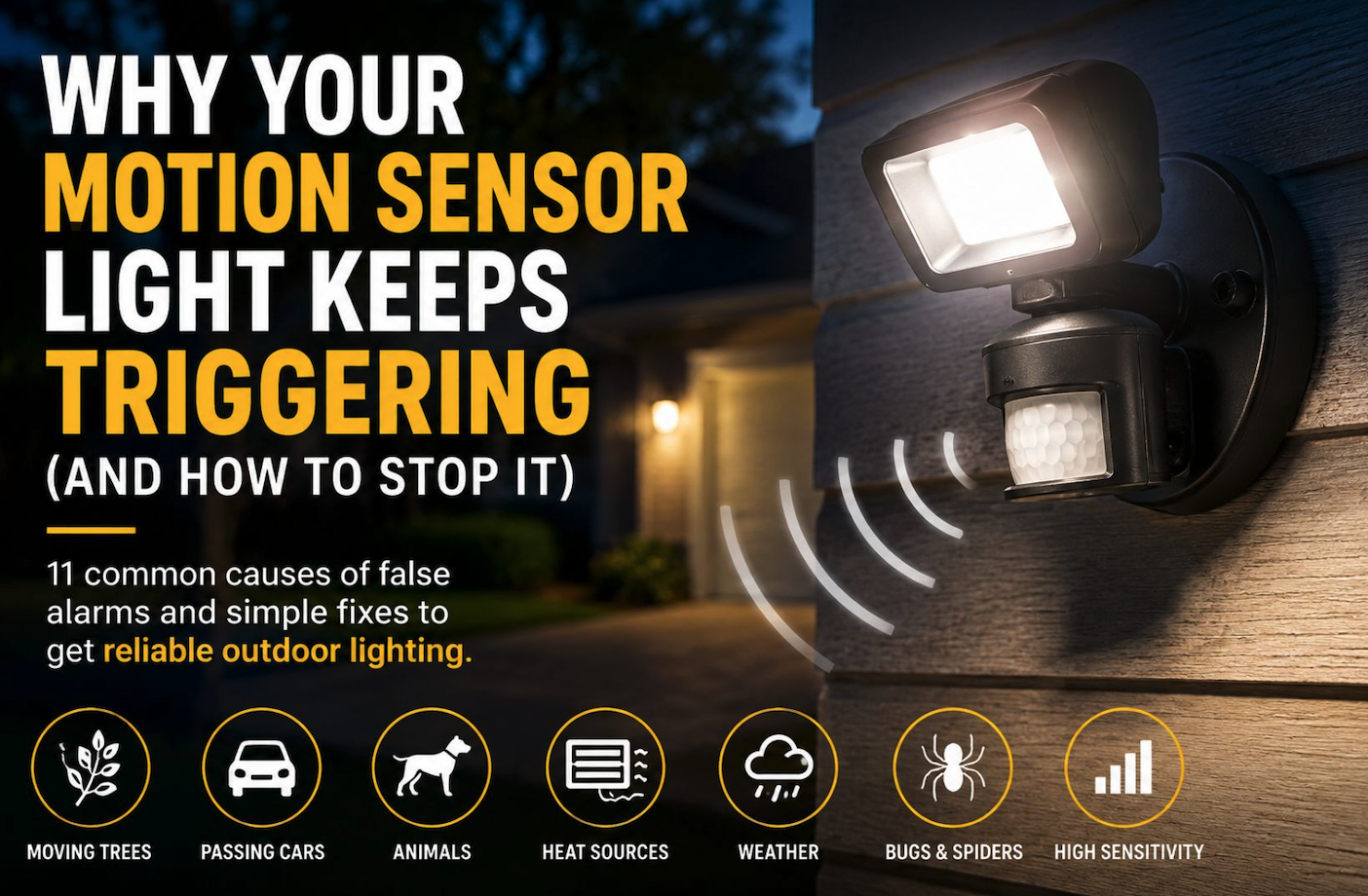
If your motion sensor light keeps triggering false alarms, the sensor itself is not always the problem. The cause may be an overly sensitive setting, moving plants, passing cars, animals, weather, heat sources, poor sensor placement, or an electrical issue.
The good news is that many nuisance activations are easy to diagnose. Others can point to an aging fixture or wiring problem that deserves a closer look.
Here is how to figure out what is triggering your outdoor light and what you can do about it.
Why Does My Motion Sensor Light Keep Going Off?
Motion activated lights are designed to detect movement within a specific detection zone. Most residential fixtures use passive infrared, or PIR, sensors.
A PIR motion sensor looks for changes in infrared energy within its field of view. A person walking across the detection area creates a noticeable change in heat patterns, which tells the fixture to turn on.
The problem is that people are not the only things capable of creating those changes.
A motion sensor may also react to:
- Animals moving through the yard
- Tree branches blowing in the wind
- Passing vehicles
- HVAC equipment
- Dryer vents
- Changes in sunlight and shadows
- Heavy rain or snow
- Insects near the sensor
- A sensor aimed at too large an area
When false triggering becomes frequent, the first step is identifying what the sensor can actually “see.”
1. Your Motion Sensitivity Is Set Too High
Start with the simplest explanation.
Many outdoor motion detector lights have an adjustable sensitivity or range setting. When sensitivity is set too high, the sensor may detect activity much farther away than you intended.
That can include a person walking along the sidewalk, a vehicle entering a neighbor’s driveway, or an animal crossing the edge of your property.
How to Fix It
Look for a sensitivity control on the fixture. Depending on the model, it may be labeled:
- SENS
- Sensitivity
- Range
- Detection
- Low, Medium, High
Reduce the sensitivity slightly and test the light.
Avoid immediately turning the setting all the way down. You still want the fixture to detect someone approaching your home. The goal is to create a useful detection zone without monitoring half the neighborhood.
2. The Sensor Is Pointed in the Wrong Direction
Sensor placement has a major effect on performance.
A motion sensor aimed directly toward a street or sidewalk may constantly detect activity that has nothing to do with your property.
There is another important consideration: many PIR sensors detect movement across their field of view more effectively than movement traveling directly toward them.
A properly positioned sensor should focus on the area where you actually need detection, such as:
- A driveway
- Front walkway
- Side yard
- Backyard entrance
- Garage
- Patio
- Gate
If your sensor is pointed toward a busy street, neighboring property, or large open area, repositioning it may dramatically reduce false alarms.
3. Trees and Plants Are Triggering the Sensor
Landscaping is one of the easiest nuisance triggers to overlook.
Branches, shrubs, tall ornamental grasses, hanging plants, and other vegetation can move constantly during windy Colorado weather.
Movement alone does not necessarily trigger every PIR sensor. However, moving vegetation combined with changing sunlight, warm surfaces, or other environmental conditions can create enough variation to activate some fixtures.
Watch the detection area during a windy afternoon.
If branches repeatedly move directly in front of the sensor, trim the vegetation or adjust the sensor away from it.
This is especially worth checking if your light seems to activate more often when the weather gets windy.
4. Animals Are Setting Off the Light
You may not see anything outside when the light comes on, but that does not mean nothing was there.
Cats, rabbits, raccoons, squirrels, deer, and other animals can activate outdoor motion sensors.
Small animals can be particularly difficult to spot from inside your home.
If the false alarms tend to happen at night, consider temporarily using a security camera to see what is moving through the detection area.
You may discover that your malfunctioning motion light is actually working exactly as designed.
Reducing sensitivity or changing the angle of the sensor can often prevent smaller animals from triggering it while maintaining useful security coverage.
5. Passing Cars Are Within the Detection Zone
This is especially common with motion lights installed near front garages and driveways.
A sensor pointed toward the street may detect vehicles passing your home. Headlights, moving vehicles, warm engines, and changing heat patterns can all contribute to unwanted activation depending on the sensor technology and placement.
Try angling the sensor downward and toward your property.
You want to cover the driveway or walkway rather than the road beyond it.
If changing the sensor position causes large gaps in the area you want protected, the fixture may simply be installed in the wrong location.
6. Your HVAC System or Dryer Vent Is Nearby
Motion sensors and heat sources do not always make good neighbors.
Remember that a PIR sensor responds to changes in infrared energy. If it is positioned near equipment that regularly creates changing heat patterns, nuisance activation can occur.

Potential sources include:
- Outdoor HVAC equipment
- Heat pump equipment
- Dryer exhaust vents
- Exhaust fans
- Warm exterior surfaces
- Other heat producing equipment
Pay attention to whether the light activates when another appliance or system starts running.
If there is a consistent pattern, sensor placement may be the real problem.
Relocating or replacing the fixture may provide better results than endlessly adjusting its sensitivity.
7. Bugs or Spider Webs Are Near the Sensor
Sometimes the culprit is tiny.
Outdoor lights attract insects. Insects attract spiders. Before long, the fixture may have webs or bugs directly in front of the motion sensor.
An insect crawling close to a sensor can appear much larger to the detection system than you might expect.
Turn the light off safely and inspect the fixture.
Clean dirt, webs, insects, and debris from the sensor lens and surrounding fixture. Avoid damaging or scratching the lens.
Regular cleaning is a simple way to keep outdoor lighting working properly.
8. Weather Is Causing False Triggers
Denver and the surrounding Front Range can throw plenty of changing weather at outdoor electrical equipment.
Strong wind, blowing snow, heavy rain, rapidly changing cloud cover, and temperature swings may contribute to nuisance triggering, particularly with older or inexpensive sensors.
If the problem happens almost exclusively during bad weather, inspect the fixture itself.
Look for:
- Cracked housings
- Loose components
- Damaged seals
- Water inside the fixture
- Corrosion
- A loose sensor head
Outdoor electrical fixtures should be designed and installed for the conditions where they are located.
Water entering a fixture is more than an inconvenience. It can become an electrical safety concern and should be addressed.
9. The Motion Sensor Needs to Be Reset
Sometimes the sensor’s controls or operating mode can become stuck.
Before assuming that the fixture needs replacement, try resetting it according to the manufacturer’s instructions.
Some fixtures can be reset by shutting off power for a specific period and restoring it. However, reset procedures vary between manufacturers and models.
We have a separate guide covering how to reset a motion sensor light that’s stuck, including common reasons a light may stay on or stop responding normally.
If resetting the fixture temporarily fixes the problem but the false triggering quickly returns, there is probably another underlying cause.
10. The Fixture Is Old or the Sensor Is Failing
Outdoor fixtures have a difficult job.
They spend years exposed to sunlight, moisture, snow, temperature swings, insects, and other environmental conditions. Eventually, electronic components can deteriorate.
An aging motion sensor may become increasingly unpredictable.
You might notice:
- Random activation
- Reduced detection range
- Excessive sensitivity
- Failure to detect obvious movement
- Lights staying on longer than expected
- Intermittent operation
If adjustments and cleaning do not solve the problem, replacing the fixture may be more practical than continuing to troubleshoot an old sensor.
Modern outdoor lighting can also offer improved detection controls, LED efficiency, adjustable coverage, dusk to dawn settings, and smart controls.
11. There May Be a Wiring Problem
This is where troubleshooting moves beyond simple sensor adjustments.
If a motion light behaves erratically even after you have ruled out environmental triggers, the problem could involve the electrical connection.
Possible issues include:
- Loose wiring connections
- Damaged wiring
- Moisture inside an electrical box
- Deteriorated wire connections
- A failing switch
- Improper fixture installation
- Problems with the branch circuit
Electrical issues can create intermittent behavior that looks like a bad motion sensor.
For example, a loose connection may cause a fixture to cycle unexpectedly. Moisture entering an exterior electrical box can also cause corrosion and unreliable operation.
If you see damaged wiring, scorching, corrosion, water intrusion, or other signs of electrical damage, stop troubleshooting the fixture and have a licensed electrician inspect it.
How to Stop a Motion Sensor Light From False Triggering
If you are not sure where to begin, work through the problem systematically.
Step 1: Clean the Sensor
Remove dirt, spider webs, insects, and debris from the sensor lens.
Step 2: Reduce the Sensitivity
Lower the sensitivity one setting at a time. Test the security light after each adjustment.
Step 3: Narrow the Detection Area
Angle the sensor away from roads, sidewalks, neighboring properties, trees, and other unnecessary areas.
Step 4: Watch for Environmental Triggers
Pay attention to when the false alarms occur.
Is it windy? Did the air conditioner turn on? Are cars passing? Does it happen only after dark?
Patterns can reveal the cause.
Step 5: Reset the Fixture
Follow the manufacturer’s reset procedure if the light appears to be behaving abnormally.
Step 6: Inspect the Fixture
Look for cracks, water intrusion, corrosion, loose components, or obvious physical damage.
Do not disassemble electrical components unless you are qualified to work on them.
Step 7: Consider the Fixture’s Age
If the light is old and continues malfunctioning after basic troubleshooting, replacement may make more sense.
Step 8: Have the Wiring Checked
If a newer fixture continues to behave unpredictably, or you notice signs of electrical damage, an electrical inspection can determine whether the problem is the fixture or the circuit supplying it.
Should You Repair or Replace Your Motion Sensor Light?
Not every nuisance trigger means you need a new light.

If adjusting the detection area or sensitivity solves the problem, there is little reason to replace a functioning fixture.
Replacement becomes more attractive when the fixture:
- Is several years old
- Has visible weather damage
- Has moisture inside it
- Cannot maintain reliable settings
- Has a failing sensor
- Provides poor coverage
- Uses outdated or inefficient lighting
- Continues triggering without an identifiable cause
This can also be an opportunity to reconsider your outdoor lighting layout.
Instead of simply replacing one fixture in the same location, a licensed electrician can evaluate whether a different mounting position or lighting design would provide better security system and fewer nuisance activations.
When Should You Call an Electrician?
Sensitivity settings, sensor positioning, and basic cleaning are reasonable things for homeowners to check.
Electrical problems are different.
Consider calling an electrician when:
- The fixture has damaged or exposed wiring
- Water has entered the electrical box
- The light flickers or loses power
- A breaker trips
- Multiple exterior lights behave strangely
- The fixture was recently installed but has never worked correctly
- Replacing or resetting the sensor does not solve the problem
- There are signs of overheating or electrical damage
An electrician can determine whether you have a defective fixture, installation problem, damaged exterior wiring, or another issue within the electrical system.
For homeowners in the Denver area, The Electricians can inspect troublesome outdoor lighting, repair wiring issues, replace failed fixtures, and install new exterior lighting where better coverage is needed.
Frequently Asked Questions
Why does my motion sensor light turn on when nothing is there?
There may still be something within the detection area. Animals, insects, moving vegetation, passing cars, heat sources, and changing environmental conditions can trigger some motion sensors. High sensitivity or poor sensor placement can also make false activations more common.
How do I stop my motion sensor light from triggering constantly?
Start by cleaning the sensor, reducing its sensitivity, and narrowing the detection zone. Aim it away from streets, moving plants, HVAC equipment, and other unnecessary areas. If the problem continues, reset the fixture and inspect it for weather damage or moisture.
Can wind trigger a motion sensor light?
Wind itself generally is not what a PIR sensor detects. However, wind can move branches, plants, decorations, and other objects within the sensor’s field of view. Combined with changing heat or sunlight patterns, this may cause nuisance activation.
Can bugs set off motion sensor lights?
Yes. Insects moving very close to the sensor can sometimes trigger outdoor motion lights. Spider webs around the sensor can also create problems. Cleaning the fixture and sensor periodically can help.
Why does my motion sensor light keep coming on at night?
Nighttime false alarms may be caused by animals, insects, passing vehicles, overly broad detection settings, or a failing sensor. Observe when the activations happen and look for a pattern before replacing the fixture.
Can a bad motion sensor cause a light to turn on randomly?
Yes. Sensors can deteriorate over time because of age, moisture, heat, sunlight, and other outdoor conditions. If cleaning, repositioning, resetting, and sensitivity adjustments do not help, the sensor or fixture may be failing.
Can faulty wiring cause a motion light to malfunction?
Yes. Loose connections, damaged wiring, moisture, corrosion, or an installation problem can cause unreliable operation. If basic sensor troubleshooting does not resolve the issue, an electrician can inspect the fixture and circuit.
Is it better to replace an old motion light?
Replacement may be worthwhile when a fixture has weather damage, an unreliable sensor, poor detection coverage, or repeated problems. A newer LED or smart outdoor lighting system may also provide better control over sensitivity, detection zones, and operating schedules.
Related Posts
If you enjoyed reading this, then please explore our other articles below:



Electrical Panels in Colorado Homes
Many homes across Colorado, especially in Denver, Aurora, Lakewood, and Colorado Springs, were built with electrical panels that were never designed for modern power demands. Cold winters, EV charging, home offices, and newer appliances place added stress on older panels and breakers.
If you are noticing frequent breaker trips, buzzing sounds, or planning an upgrade like an EV charger or heat pump, a licensed Colorado electrician can evaluate whether your panel needs repairs or a full power upgrade.