If it’s time for a new water heater, you have a decision to make:
Tank or tankless?
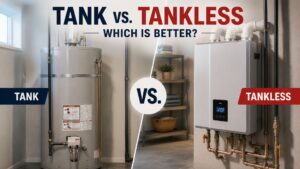
Traditional tank water heaters cost less upfront and work well for many homes. Tankless water heaters take up less space, can provide continuous hot water, and may use less energy.
But that doesn’t automatically make tankless better.
The best choice depends on your household, hot water use, existing plumbing, gas or electrical system, budget, and how long you plan to stay in your home.
Here’s how tank vs. tankless water heaters compare and what Denver homeowners should consider before making the switch.
Tank vs. Tankless Water Heater at a Glance
| Feature | Tank Water Heater | Tankless Water Heater |
|---|---|---|
| Upfront Cost | Lower | Higher |
| Hot Water Supply | Limited by tank size | Continuous when properly sized |
| Energy Efficiency | Lower | Generally higher |
| Space Required | More | Less |
| Installation | Usually simpler | Can require upgrades |
| Typical Lifespan | About 8–12 years | Often 15–20+ years |
| Best For | Lower upfront cost and simple replacement | Efficiency, space savings, and continuous hot water |
Neither option wins every category.
Let’s look at the differences.
How Does a Tank Water Heater Work?
A traditional water heater stores hot water in a large insulated tank.
Common residential sizes include:
- 40 gallons
- 50 gallons
- 65 gallons
- 75 gallons
- 80 gallons
The system heats the stored water and keeps it ready until you turn on a faucet or appliance.
As you use hot water, cold water enters the tank and the water heater begins heating it.
This design is simple and proven.
The biggest limitation is capacity.
If your family uses all the stored hot water, you’ll need to wait for the tank to recover.
How Does a Tankless Water Heater Work?
A tankless water heater doesn’t store a large supply of hot water.
Instead, it heats water when you need it.
When you open a hot water faucet, water moves through the unit and a gas burner or electric heating element heats it.
When you shut off the faucet, the system stops heating.
This is why tankless systems are also called on-demand water heaters.
Because there isn’t a tank holding hot water all day, the system can reduce standby energy loss.
Is Tankless More Energy Efficient?
Usually.
Traditional tank water heaters maintain a supply of hot water even when you’re not using it.
Tankless systems avoid much of that standby heat loss because they heat water on demand.
According to the U.S. Department of Energy, on-demand water heaters can be 24% to 34% more energy efficient than conventional storage water heaters in homes using 41 gallons or less of hot water per day.
For households using about 86 gallons per day, the efficiency advantage may be closer to 8% to 14%.
That doesn’t mean your utility bill will suddenly drop by 34%.
Actual savings depend on:
- Hot water use
- Fuel type
- Equipment efficiency
- Energy prices
- Household size
- Installation
- Maintenance
Tankless can save energy, but you should compare those long-term savings against the higher installation cost.
Which Costs More to Install?
Tankless usually costs more.
A traditional tank replacement can often use much of the home’s existing plumbing, gas, venting, or electrical setup.
A tankless conversion may require more work.
That could include:
- Larger gas piping
- New venting
- Plumbing modifications
- New electrical wiring
- A dedicated circuit
- A different equipment location
That’s why you should compare the total installed cost, not just the price of the water heater.
A tankless unit sitting on a store shelf might not look dramatically more expensive.
The conversion work can be.
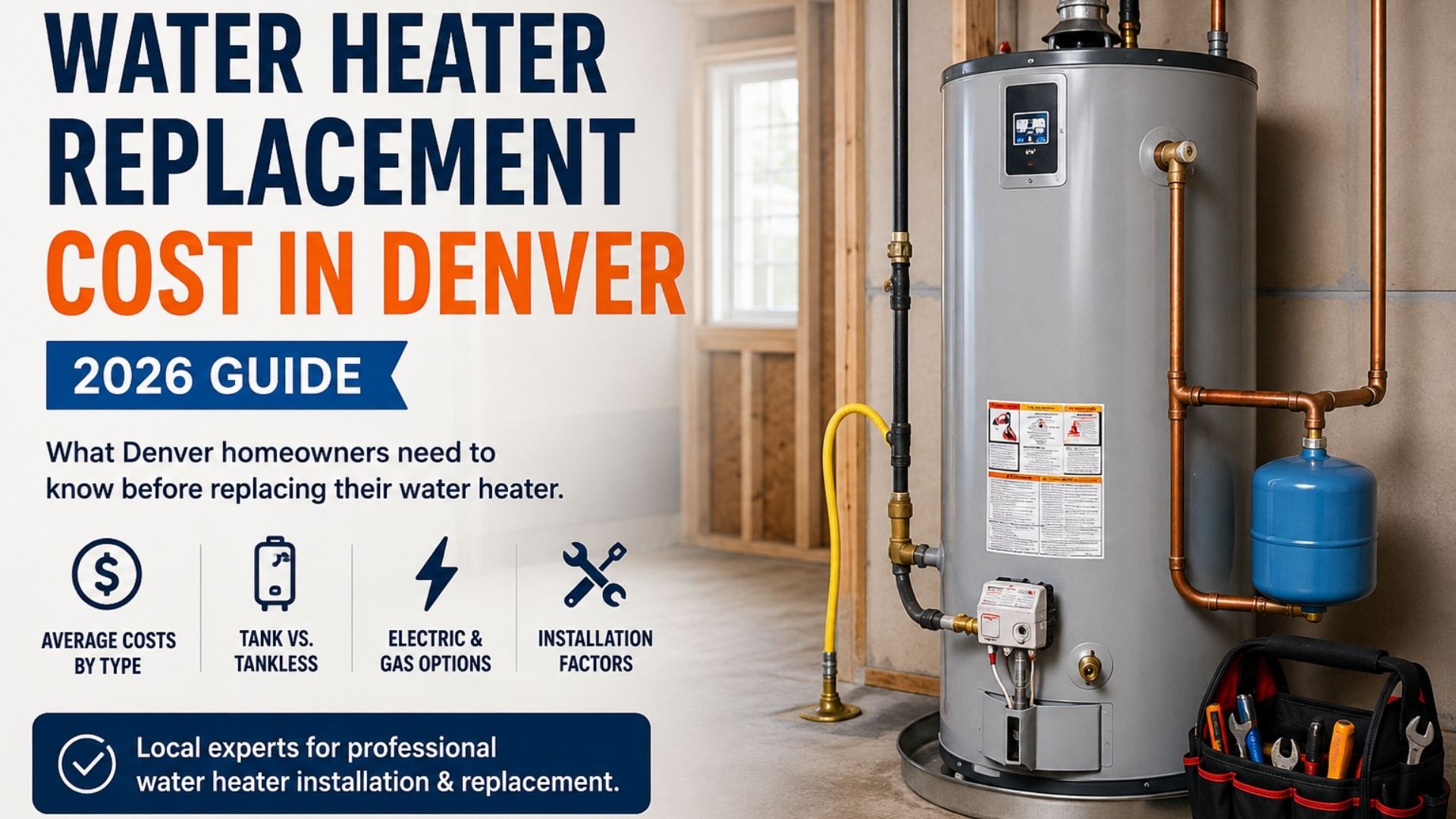
For a deeper look at local pricing, see our Water Heater Replacement Cost in Denver: 2026 Guide.
Does Tankless Mean Unlimited Hot Water?
Sort of.
This is one of the biggest misunderstandings about tankless water heaters.
A properly sized tankless unit can continue producing hot water for as long as needed.
You aren’t limited to the 40 or 50 gallons stored in a tank.
But tankless systems still have limits.
The important number is flow rate.
If you’re simultaneously running:
- Two showers
- A dishwasher
- A washing machine
- A sink
you may demand more hot water than the unit can produce at once.
Colorado’s colder incoming water can also matter.
The colder the water entering the home, the more the tankless system must heat it before sending it to your faucet.
That’s why proper sizing is critical.
Don’t buy a tankless water heater based only on the number of bathrooms in your home.
Your contractor should evaluate expected flow rate and temperature rise.
Which Water Heater Lasts Longer?
Tankless generally wins this category.
Traditional tank water heaters commonly last around 8 to 12 years, although some last longer with good maintenance and favorable water conditions.
Tankless units can often last 15 to 20 years or longer when properly installed and maintained.
There is a reason for the difference.
A traditional water heater constantly stores dozens of gallons of water. Over time, corrosion and sediment can take a toll on the tank.
Tankless systems don’t have a large storage tank that can eventually rust through.
That doesn’t mean they’re maintenance-free.
They still need regular service.
Do Tankless Water Heaters Need Maintenance?
Yes.
Tankless does not mean maintenance-free.
Minerals can build up inside the heat exchanger.
Periodic flushing or descaling may be recommended depending on the equipment and water conditions.
Maintenance can help:
- Maintain efficiency
- Protect the heat exchanger
- Maintain water flow
- Reduce mineral buildup
- Extend equipment life
Traditional tank water heaters need maintenance too.
Sediment can collect at the bottom of the tank over time, which can affect performance and contribute to popping or rumbling sounds.
Whichever system you choose, follow the manufacturer’s maintenance recommendations.
Which Takes Up Less Space?
Tankless wins easily.
A traditional water heater may hold 40 to 80 gallons and requires enough floor space for the tank.
A tankless unit is much smaller and typically mounts on a wall.
That can be valuable when the water heater is located in a:
- Small utility room
- Mechanical room
- Closet
- Garage
- Finished basement
Removing a large tank can free up useful floor space.
Tank or Tankless for a Large Family?
This depends more on how your family uses hot water than how many people live in the house.
A large tank can work well when your household has predictable hot water needs.
Tankless can be attractive if family members regularly take showers one after another and the existing tank keeps running out.
But simultaneous use matters.
A tankless unit has to be sized to handle the amount of hot water your family might need at the same time.
For example, three showers running at once can require much more capacity than three showers taken one after another.
This is why correct sizing matters more than simply choosing “tankless.”
Gas vs. Electric Tankless Water Heaters
Tankless systems can use natural gas or electricity.
Gas Tankless
Gas models are common for whole-home applications because they can provide high heating output.
Converting from a traditional gas tank may require:
- Gas line modifications
- New venting
- Condensate drainage
- Electrical power for controls
Your existing gas line should be evaluated to make sure it can support the new equipment.
Electric Tankless
Whole-home electric tankless systems can require a significant amount of electrical power.
Depending on the equipment, your home may need:
- Multiple dedicated circuits
- Larger breakers
- New wiring
- Additional electrical panel capacity
- Potential electrical service upgrades
This is especially important in older Denver homes.
Before purchasing an electric tankless system, have the electrical requirements evaluated.
What About Heat Pump Water Heaters?
Tank and tankless aren’t your only choices.
Heat pump water heaters are becoming another option for homeowners who want to reduce energy use.
A heat pump water heater typically uses a storage tank, but it heats the water differently.
Instead of generating heat directly, it moves heat from the surrounding air into the water.
That can make it much more efficient than a traditional electric resistance water heater.
Heat pump systems do have specific installation requirements, including space, airflow, condensate drainage, and electrical power.
For homeowners interested in electrification, they’re worth considering alongside tankless.
Is Tankless Better for Denver Homes?
Sometimes.
Tankless can be a great fit if you:
- Regularly run out of hot water
- Want to free up floor space
- Want higher energy efficiency
- Plan to stay in your home long term
- Are willing to spend more upfront
- Want equipment with a potentially longer lifespan
A traditional tank may make more sense if you:
- Want the lowest upfront cost
- Already have a tank system that works well
- Want a straightforward replacement
- Don’t regularly run out of hot water
- Don’t want to make major plumbing, gas, or electrical changes
Denver’s colder winter water temperatures should also be considered when sizing tankless equipment.
The system needs enough capacity to bring colder incoming water up to the desired temperature while still providing the flow your household needs.
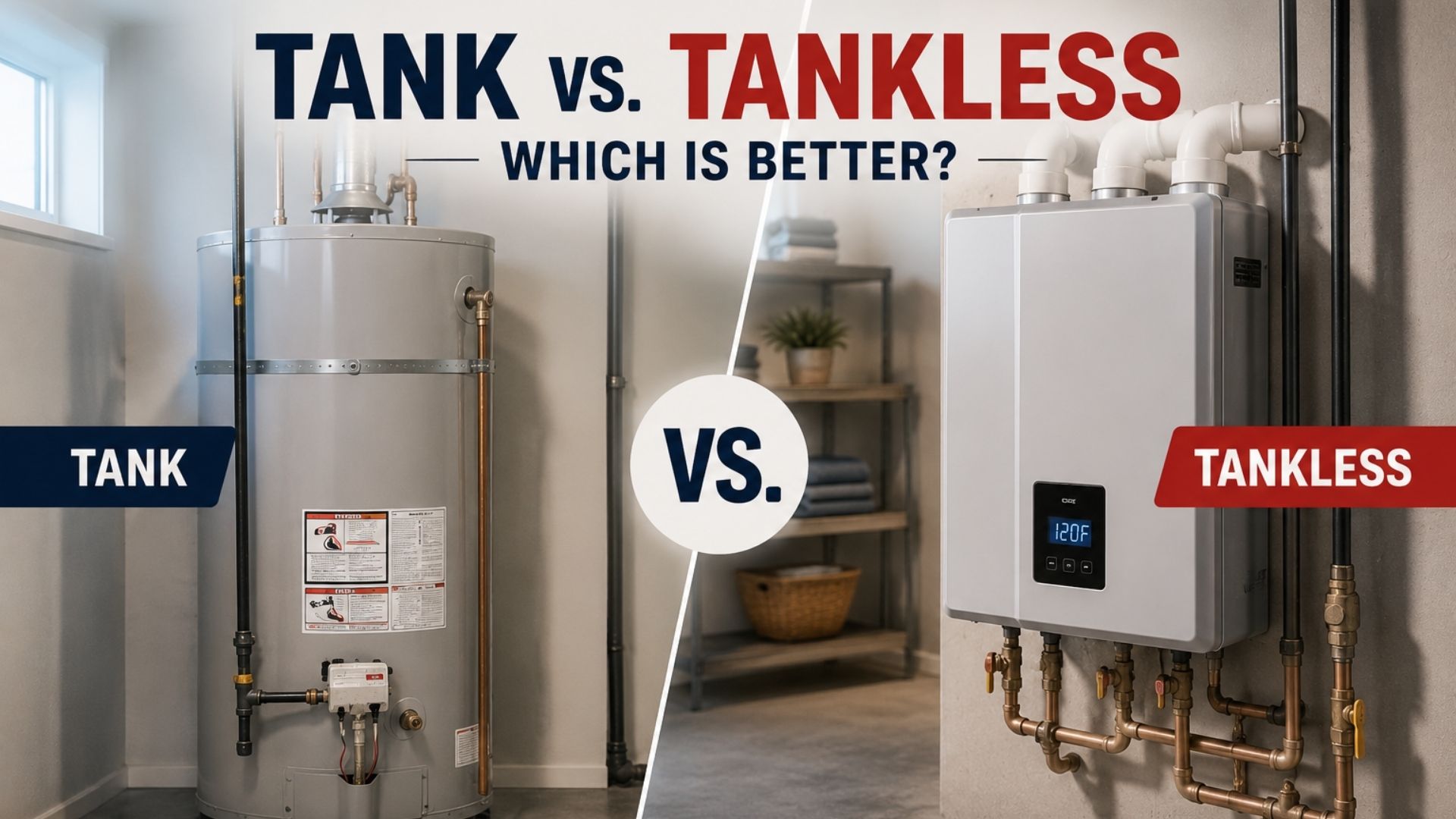
Tank vs. Tankless: Which Is Better?
There isn’t one answer for every home.
Choose a traditional tank if: you want a lower upfront cost, simple installation, and reliable hot water without major changes to your home.
Consider tankless if: continuous hot water, energy efficiency, space savings, and longer equipment life are worth the higher upfront investment.
And don’t overlook heat pump water heaters if efficiency and electrification are priorities.
The best approach is to compare the entire project.
That means looking at:
- Equipment cost
- Installation cost
- Plumbing changes
- Gas requirements
- Electrical requirements
- Expected lifespan
- Maintenance
- Long-term energy use
The cheapest water heater isn’t always the cheapest option over 15 or 20 years.
And the most expensive system isn’t automatically the best.
Frequently Asked Questions About Tank vs. Tankless Water Heaters
Is a tankless water heater worth it?
Tankless can be worth it if you value continuous hot water, energy efficiency, a smaller footprint, and longer equipment life. However, the higher installation cost means it isn’t automatically the best financial choice for every home.
What is the biggest downside of a tankless water heater?
Upfront cost is usually the biggest disadvantage. Converting from a traditional tank may require changes to gas piping, venting, plumbing, or electrical systems.
Can you run out of hot water with tankless?
You won’t empty a storage tank because there isn’t one. However, you can exceed the tankless unit’s flow capacity if too many fixtures need hot water at the same time.
Does tankless really save money?
Tankless systems can reduce energy use by eliminating much of the standby heat loss associated with storage tanks. Whether the energy savings make up for the higher installation cost depends on your household and how long you own the system.
How long does a tankless water heater last?
A properly installed and maintained tankless system can often last 15 to 20 years or longer. Traditional tank systems commonly last around 8 to 12 years.
Does a tankless water heater need electricity?
Even many gas tankless water heaters require electricity for controls, ignition, and other components. Electric tankless units can require substantial electrical capacity.
Need Help Choosing a Water Heater in Denver?
You don’t have to choose based on a sales brochure.
The right water heater depends on your home, your hot water use, your budget, and the plumbing and electrical systems already in place.
The Electricians and Plumbers provides water heater installation and replacement in Denver and surrounding Colorado communities.
Because we handle both plumbing and electrical work, we can evaluate the entire project — including the electrical requirements that can come with tankless, electric, and heat pump water heaters.
Call The Electricians and Plumbers at 720-303-0150 to schedule water heater service.
Related Posts
If you enjoyed reading this, then please explore our other articles below:
Electrical Panels in Colorado Homes
Many homes across Colorado, especially in Denver, Aurora, Lakewood, and Colorado Springs, were built with electrical panels that were never designed for modern power demands. Cold winters, EV charging, home offices, and newer appliances place added stress on older panels and breakers.
If you are noticing frequent breaker trips, buzzing sounds, or planning an upgrade like an EV charger or heat pump, a licensed Colorado electrician can evaluate whether your panel needs repairs or a full power upgrade.